You need one wardrobe. One alcove, one shoe cabinet, one vanity. You request a quotation, and the number that comes back feels out of proportion — nearly what a friend paid for three rooms of built-ins. Before concluding that the supplier is padding a small order, it helps to understand what a small job actually costs to produce, because most of that cost has nothing to do with the size of the cabinet.
What This Guide Covers
- 1. Why one cabinet costs more per cabinet
- 2. What the minimum really pays for
- 3. When a small job is still the right call
- 4. Four ways to make a small job cost less
- 5. When to choose a non-custom alternative
- 6. Getting a fair quotation for one unit
1. Why One Cabinet Costs More per Cabinet
Carpentry economics run on repetition. A workshop that cuts forty panels for one home spreads its setup time, cutting waste, and delivery across all of them. A job with six panels carries the same setup, the same survey visit, the same drawing, the same truck, and the same two-person installation crew — across six panels. The fixed costs do not shrink with the order; only the work does. That is why the per-cabinet price of a single unit is higher, and why no honest quotation can escape it.
This is also why many workshops state a minimum charge or decline very small jobs altogether. It is not disdain for small customers; it is arithmetic. The visit costs the same whether the room has one cabinet or six.
2. What the Minimum Really Pays For
Break a one-cabinet job into its real steps and the structure of the price becomes clear. There is a site survey, with travel both ways. Drawings must be produced and approved, however simple the unit. Panels are cut and edge-banded on machines that must be set up for the job. Finishing is matched to your room’s light, which may mean sampling. Hardware is ordered, often in minimum pack quantities that exceed what one cabinet uses. The unit is delivered and installed by a crew that protects floors, works a full day regardless of cabinet count, and clears the site afterwards.
Every one of those steps exists in a forty-cabinet project too. The difference is only how many cabinets share each step. Seeing the list also shows where a small job’s price can legitimately be reduced — and where it cannot.


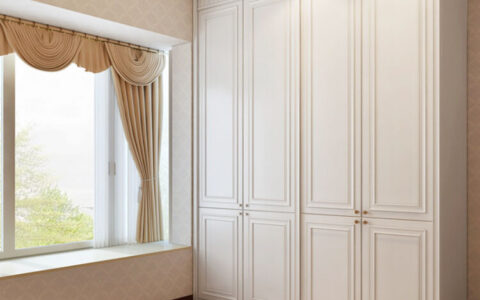
A single narrow shoe cabinet is a complete project — survey, drawing, production, delivery, installation — compressed into one unit.
3. When a Small Job Is Still the Right Call
Some problems can only be solved with made-to-measure work, whatever the per-piece price. An awkward alcove that no catalogue unit fits. A replacement for one damaged section of an existing run, where matching the finish and the hardware matters more than the cost. A narrow hallway where every centimetre of depth is contested. A height constraint under a stair or a sloped ceiling. In these cases the custom premium buys the only product that actually works, and comparing it to the price of a standard cabinet is comparing two different questions.
There is also a timing argument. If the single unit is the first of a planned sequence — one wardrobe this year, the bedroom wall next year — ordering from a workshop that keeps your drawings and finish codes turns the second order into a cheaper, faster repeat.
There is a middle path worth naming: the phased project. If your home will eventually need several built-ins, tell the supplier the full plan and order the first piece now. Workshops price a known pipeline differently from a one-off enquiry — the survey, drawings and finish references are reused, and the second quotation usually arrives faster and tighter than the first.
4. Four Ways to Make a Small Job Cost Less
- Simplify the specification, not the structure. A melamine carcass with standard hinges and one drawer instead of three can cut the price meaningfully without affecting whether the unit fits the space. Structure and fit are what you are paying a premium for; the rest can be standard.
- Batch your needs. Walk the whole home before requesting the quote. A hallway cabinet plus two wardrobe fit-out upgrades ordered together share one survey and one delivery, and the total usually lands below two separate small jobs.
- Offer scheduling flexibility. A small job that can fill a gap in a workshop’s calendar — when another installation nearby finishes early, for example — is cheaper to produce than one that demands a dedicated visit. Say so explicitly; some suppliers will price it accordingly.
- Prepare the site yourself. Removing the old unit, clearing the room, and having the wall ready removes a scope item that small jobs often carry.
One option to avoid: accepting a thinner carcass or unbranded hardware to reach a lower number. The fixed costs that make small jobs expensive do not shrink with cheaper materials, so the saving is small while the quality cost is permanent — the worst trade available on a single unit you will use every day.
5. When to Choose a Non-Custom Alternative
Honesty requires naming the cases where custom work is the wrong purchase. If a standard-height wardrobe against a flat wall solves the problem, a good ready-made unit will cost less and be delivered in days. If the need is storage rather than fit — a shoe cabinet that could stand anywhere — modular or off-the-shelf products deserve a look first. Custom earns its price when the space is difficult, the finish must match existing work, or the unit must integrate with the building. When none of those apply, paying the small-job premium for a standard problem is money spent on nothing.
6. Getting a Fair Quotation for One Unit
Small jobs are priced faster when the enquiry is complete. Provide the opening dimensions at three heights, a photo of the space with its surroundings, the contents the unit must hold, the finish you want to match if any, and your access conditions. Ask the supplier to state the fixed costs separately — survey, delivery, installation — so you can see what share of the total is logistics rather than cabinet. And ask the batch question directly: whether adding one more small unit now would change the per-piece economics more than the added unit costs.
Finally, set expectations about timing. A small job competes for the same production slots as large ones, and a workshop may reasonably quote a longer lead time for one cabinet than for a full room. If the date matters more than the price, say so early — some suppliers price small rush jobs honestly once the constraint is known.
The Short Answer
A single cabinet carries the whole project overhead on its own, which is why its per-piece price is higher — not because anyone is taking advantage. Reserve custom work for problems only it can solve, simplify the specification where you can, and batch small needs together where possible. Judged that way, a well-priced small job is not expensive; it is simply honest about its own arithmetic.
When you request the quotation, describe the job completely and ask for the fixed and variable costs separately. Firms such as SUNNY COTTAGE CO., LTD. can quote a single unit that way, and you will see exactly what you are paying for.
This article is from a submission and does not representThailand Interior Design | Whole House Customization | Sunny Cottageposition,If reproduced, please indicate the source:https://www.decorationbydiana.com/23081/